the uw-madison james watrous mosaics
UW-Madison is great in many ways. Its lakes, downtown, history, nuclear department (second best in the world if your a fusion type, but I fear Michigan has us beat in the fission department, we have a reactor though so they can suck it) create one of the best college towns in the world. But its campus can leave some to be desired - a notable lack of pedestrian only paths, cold weather, and not much public art. There is a lot of art of course, in the Chazen and in the odd building, but walking to class is often an artless affair. Thats why I think I am so fond of the James Watrous mosaics I have found.
James Watrous attended Wisconsin for his BA, MA, and PhD becoming a professor in art and art history, once again at UW. He is responsible for the creation of what is now the Chazen Art Museum. But my favorite impact he has left on UW-Madison are his mosaics interspersed around campus. I have gone on a hunt to find them all (and a painting, as a treat) and have documented them here so you can also experience his work.
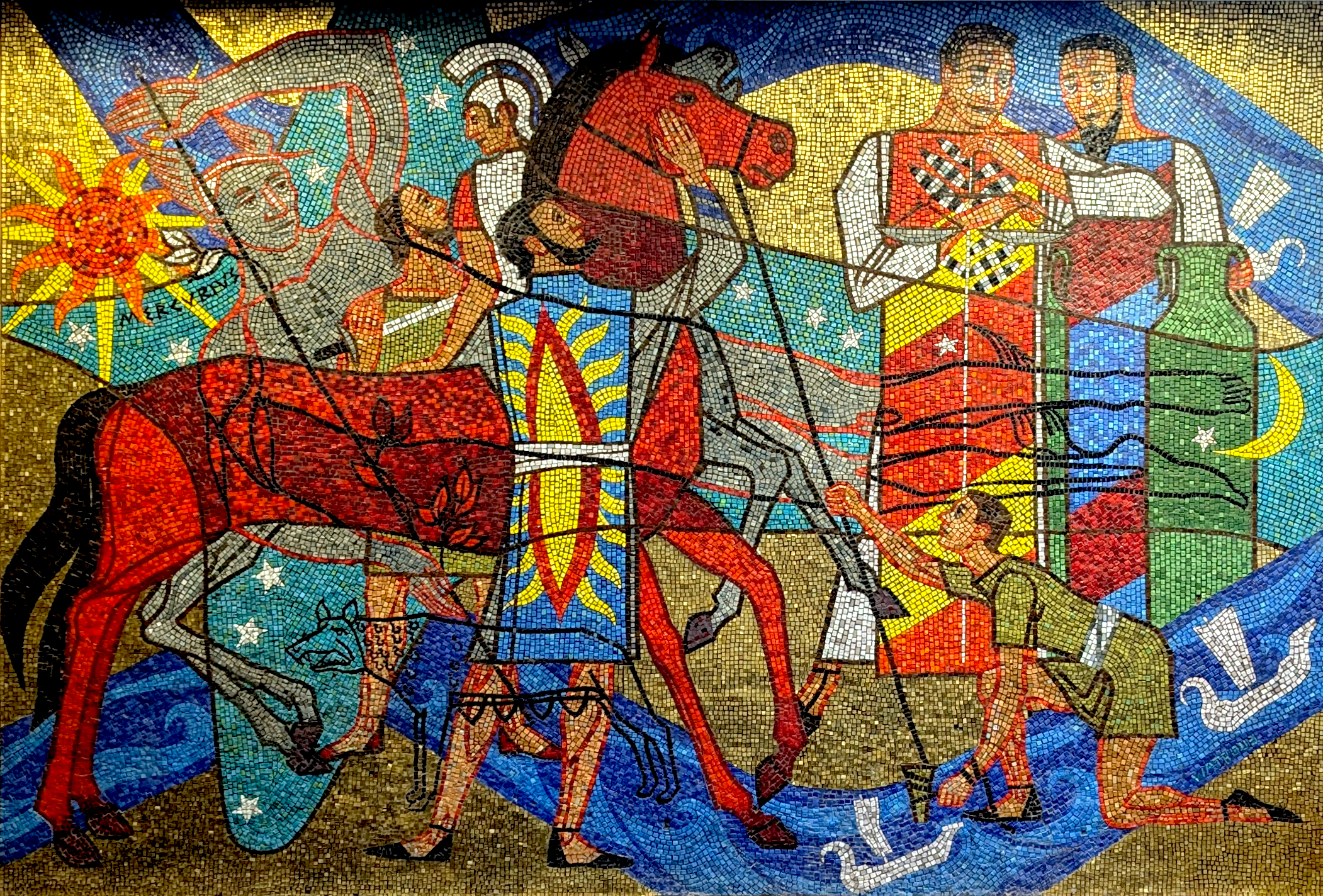
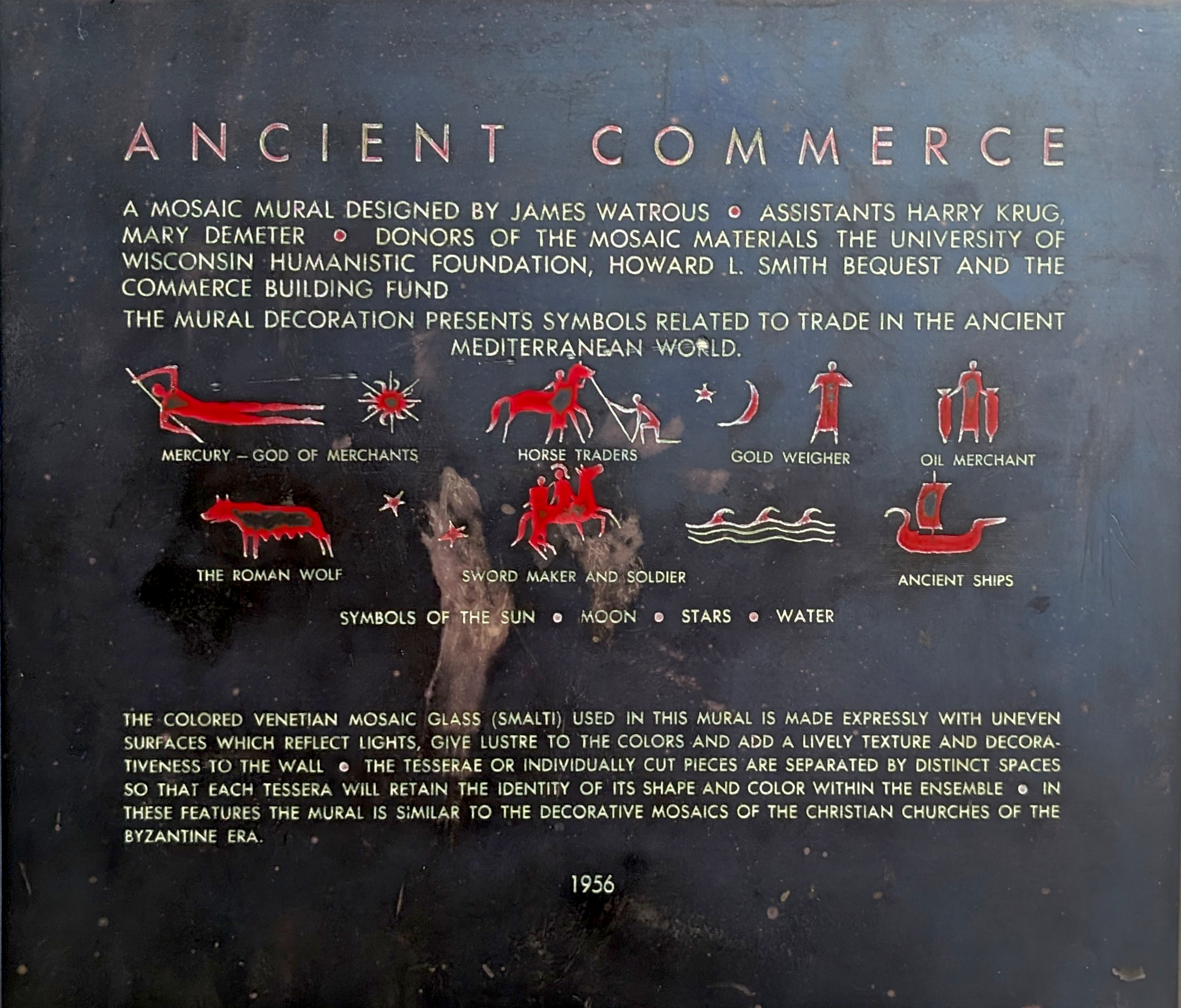
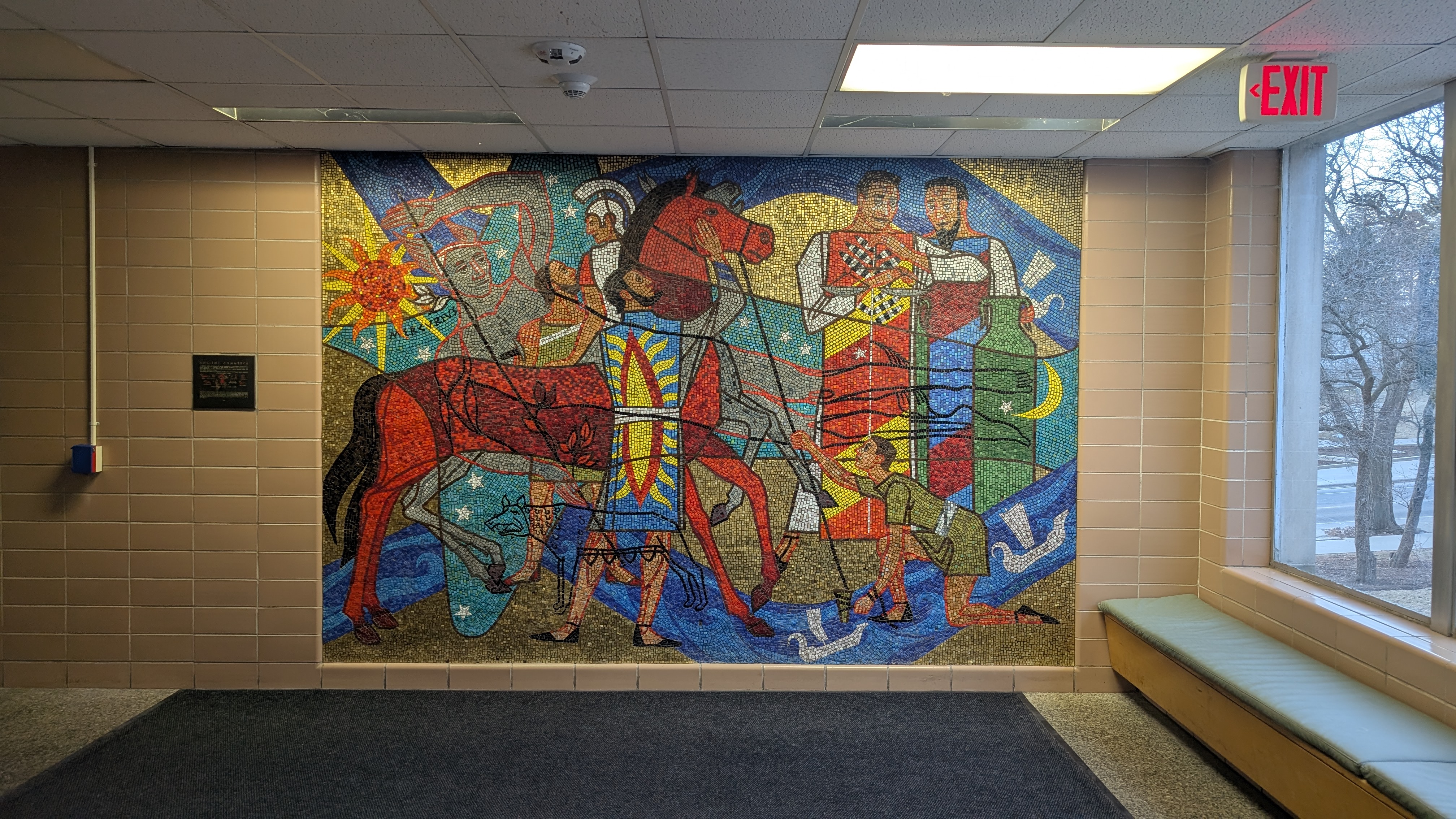
Ancient Commerce - 1956
Located in Ingraham hall, across from Contemporary Commerce.
From plaque:
A mosaic mural designed by James Watrous. Assistants Harry Krug, Mary Demeter. Donors of the mosaic materials, the University of Wisconsin Humanistic Foundation, Howard L. Smith Bequest and the Commerce Building Fund. The mural decoration presents symbols related to trade in the ancient mediterranean world:
- Mercury, God of Merchants
- Horse Traders
- Gold Weigher
- Oil Merchant
- The Roman Wolf
- Sword Maker and Soldier
- Ancient Ships
- Symbols of the Sun, Moon, Stars, Water
The colored Venetian mosaic glass (Smalti) used in this mural is made expressly with the uneven surfaces which reflect lights, give lustre to the colors and add a lively texture and decorativeness to the wall. The tesserae or individually cut pieces are seperated by distinct spaces so that each tessera will retain the identity of its shape and color within the ensemble. In these features the mural is similar to the decorative mosaics of the Christian churches of the Byzantine era.
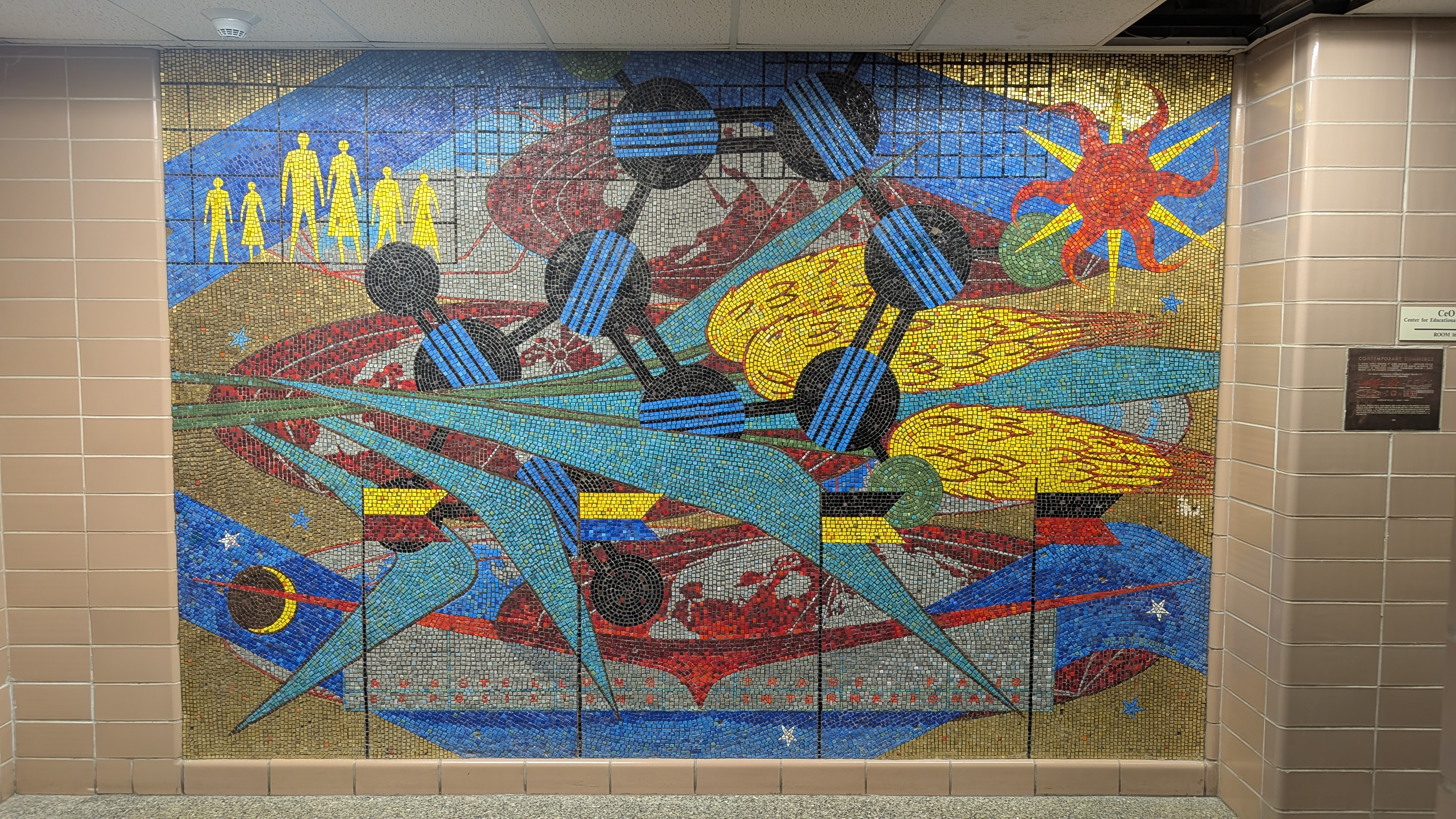
Contemporary Commerce - 1957
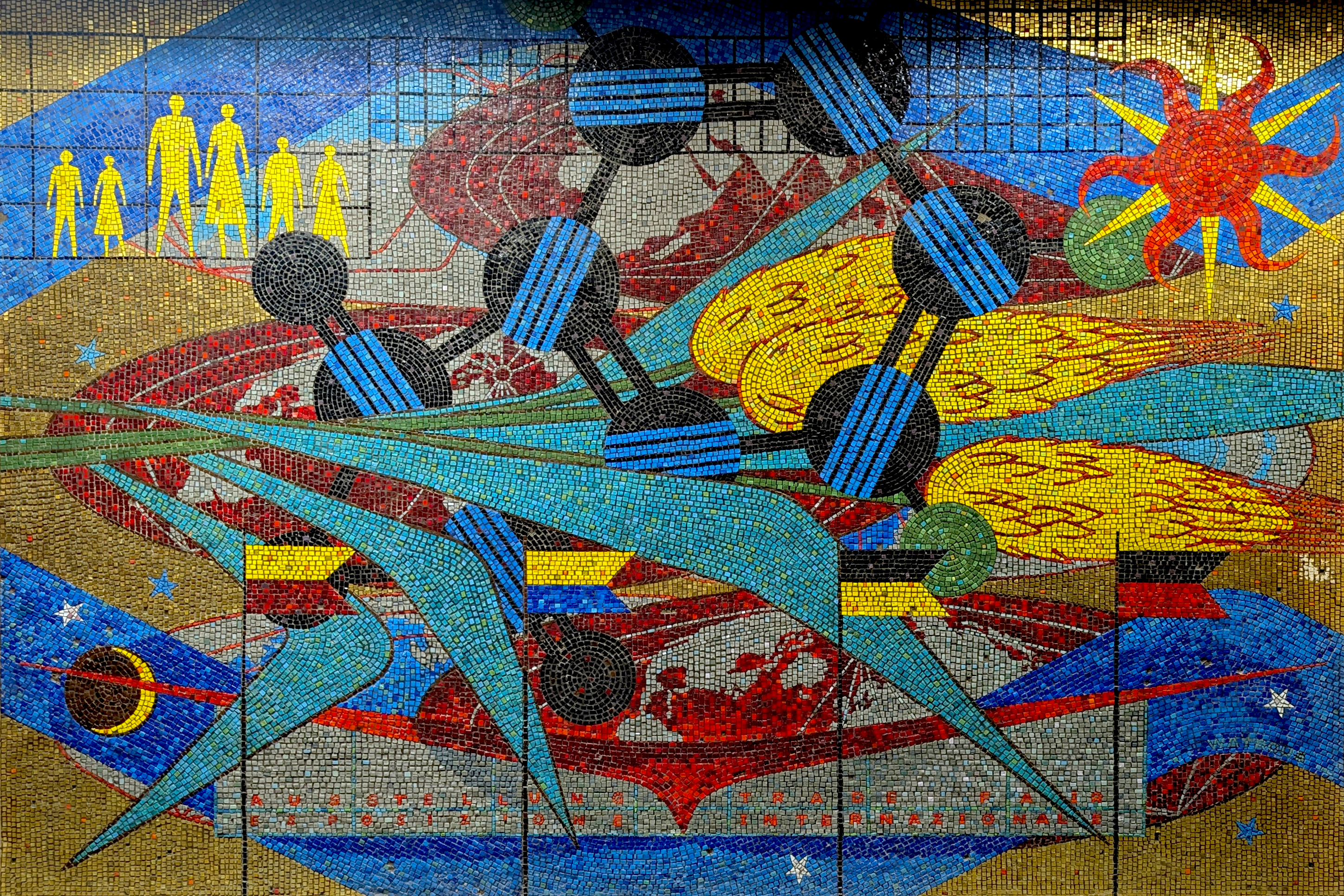
Located in Ingraham hall, across from Ancient Commerce.
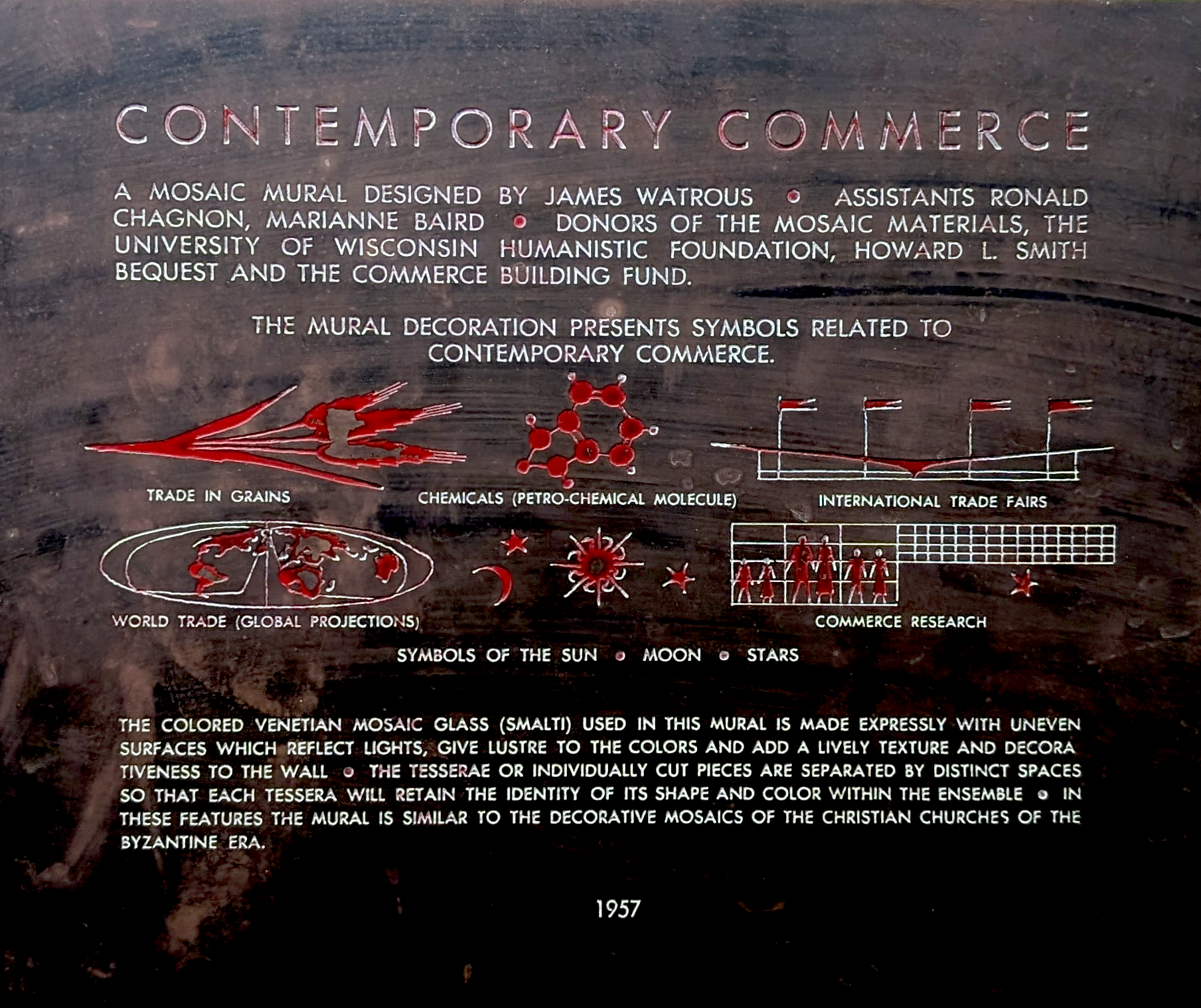
From plaque:
A mosaic mural designed by James Watrous. Assistants Ronald Chagnon, Marianne Baird. Donors of the mosaic materials, the University of Wisconsin Humanistic Foundation, Howard L. Smith Bequest and the Commerce Building Fund. The mural decoration presents symbols related to contemporary commerce:
- Trade in grains
- Chemicals (Petro-Chemical Molecule)
- International Trade Fairs
- World Trade (Global Projections)
- Commerce Research
- Symbols of the Sun, Moon, Stars
The colored Venetian mosaic glass (Smalti) used in this mural is made expressly with the uneven surfaces which reflect lights, give lustre to the colors and add a lively texture and decorativeness to the wall. The tesserae or individually cut pieces are seperated by distinct spaces so that each tessera will retain the identity of its shape and color within the ensemble. In these features the mural is similar to the decorative mosaics of the Christian churches of the Byzantine era.
Man: Creator of Order and Disorder - 1963
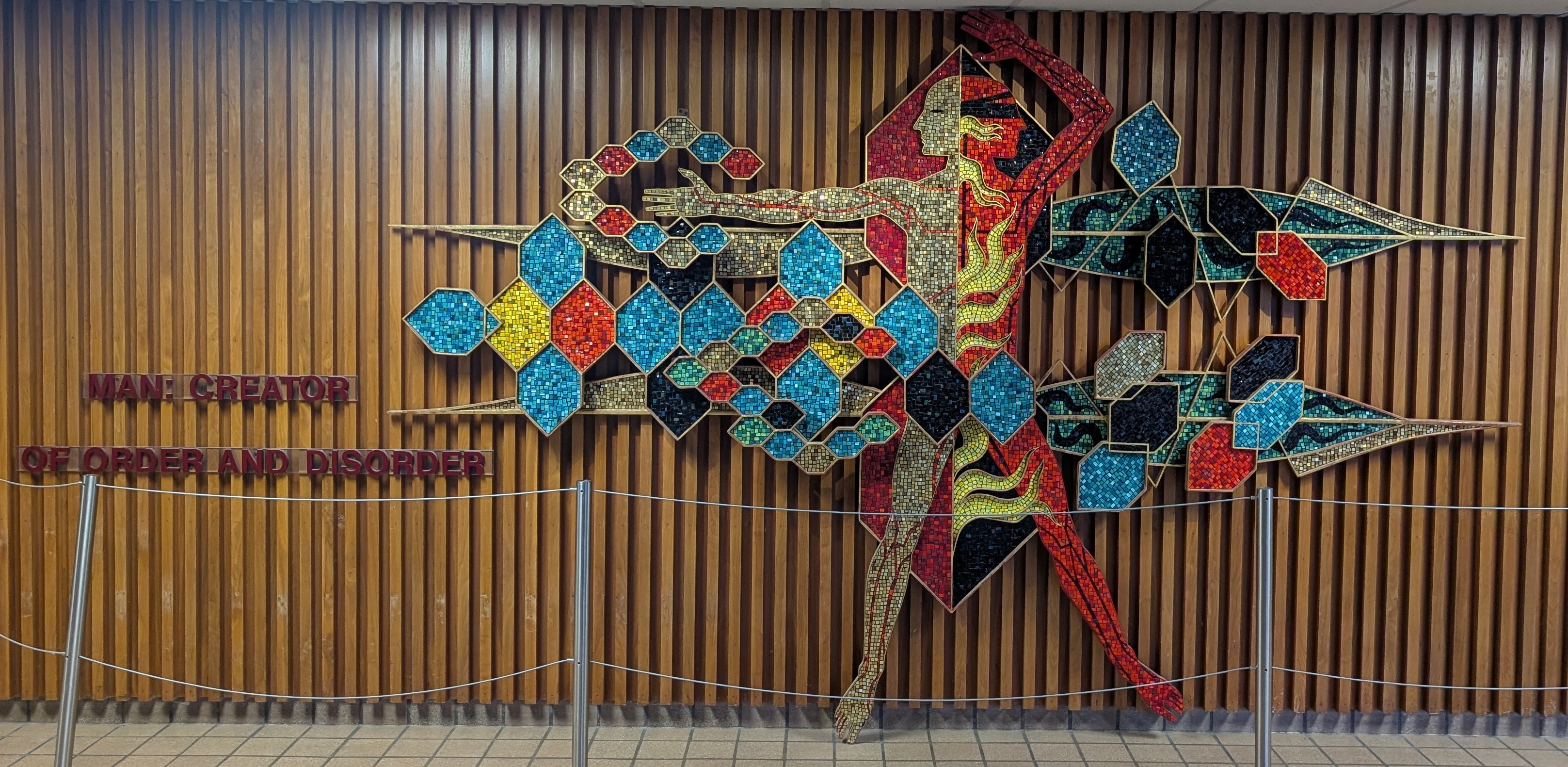
Located in the entrance of Sewell Social Sciences Building.
From plaque:
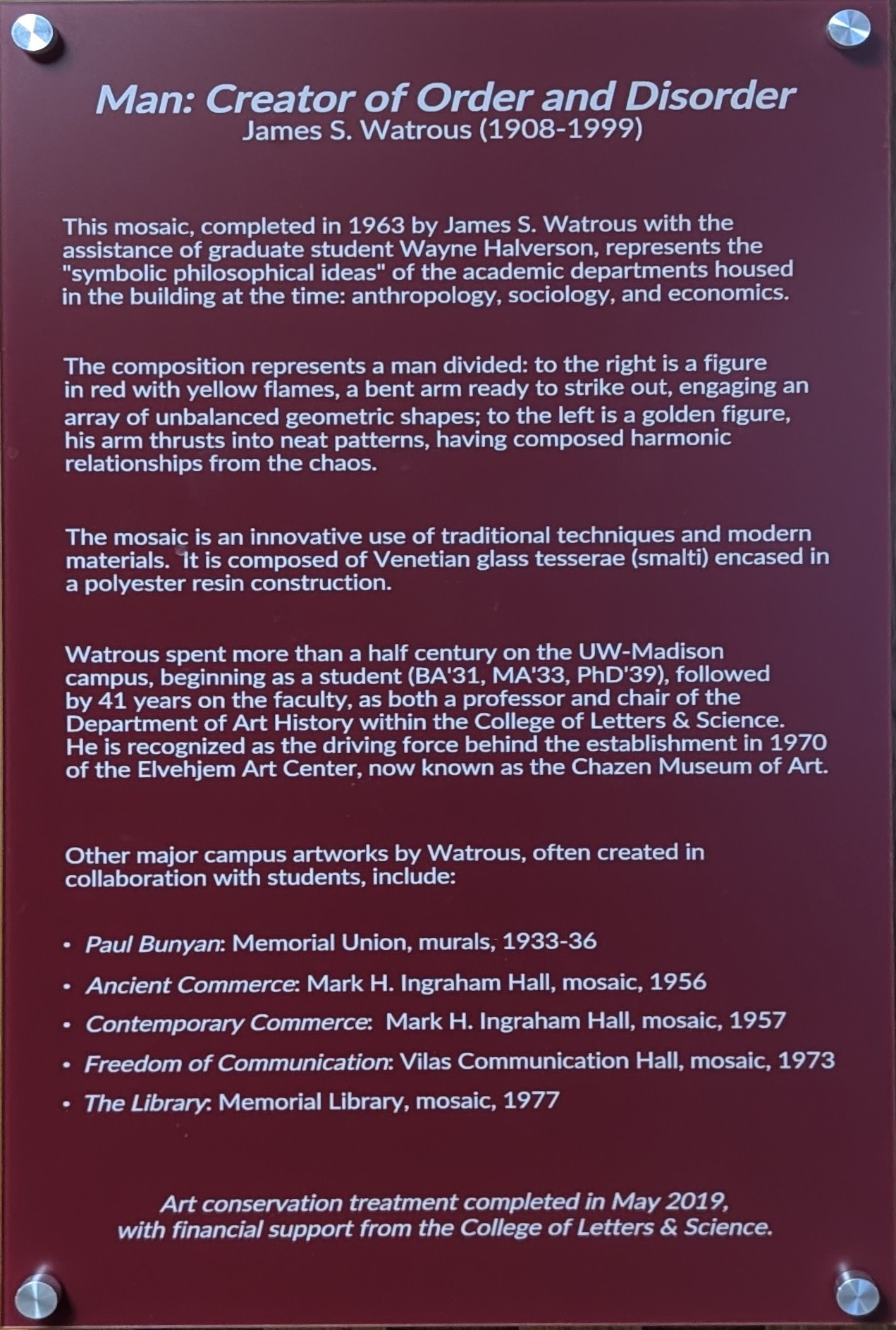
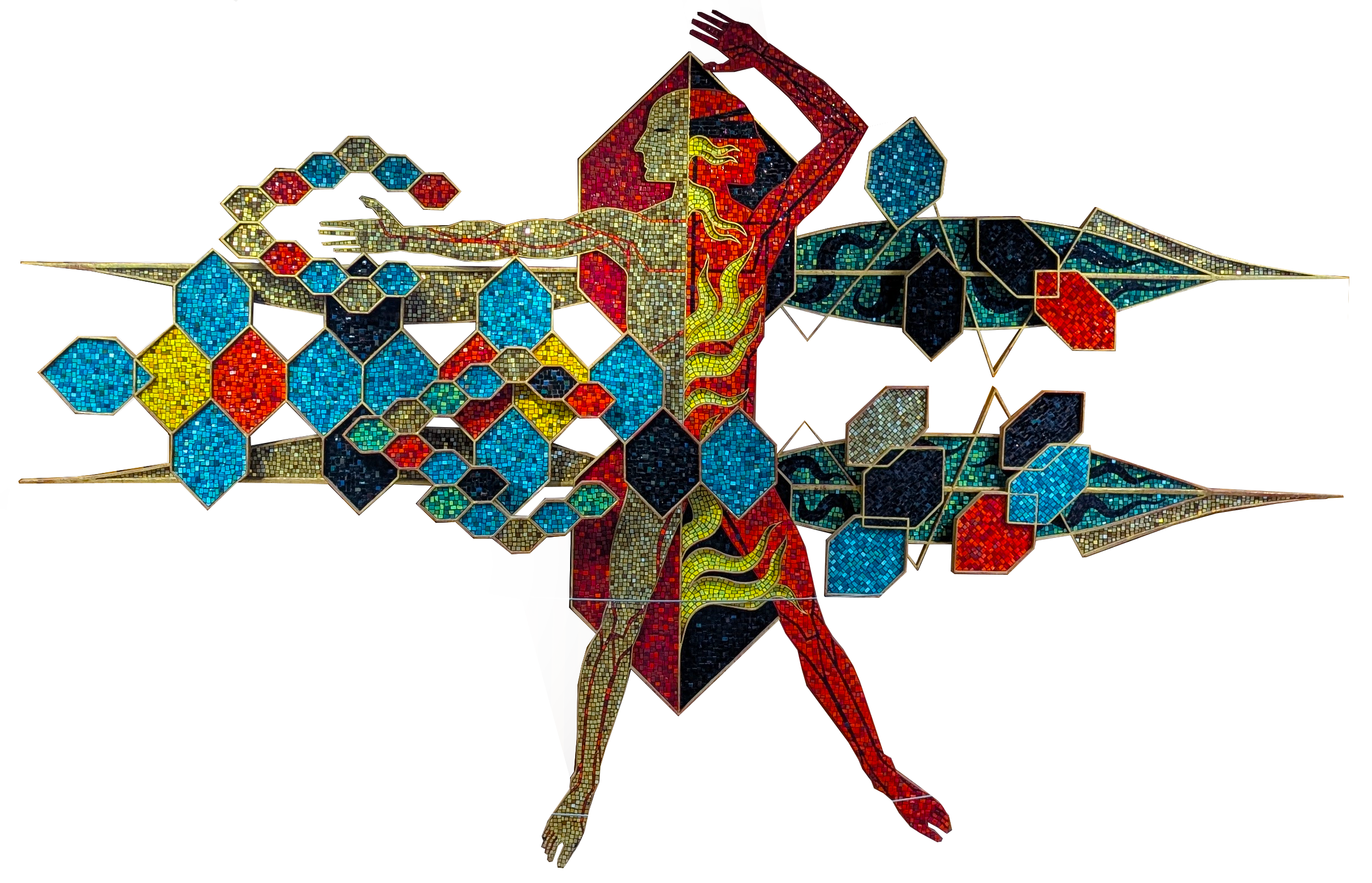
The mosaic, completed in 1963 by James S. Watrous with the assistance of graduate student Wayne Halverson, represents the "symbolic philosophical ideas" of the academic departments housed in the building at the time: anthropology, sociology, and economics.
The composition represents a man divided: to the right is a figure in red with yellow flames, a bent arm ready to strike out, engaging an array of unbalanced geometric shapes; to the left is a golden figure, his arm thrusts into neat patterns, having composed harmonic relationships from the chaos.
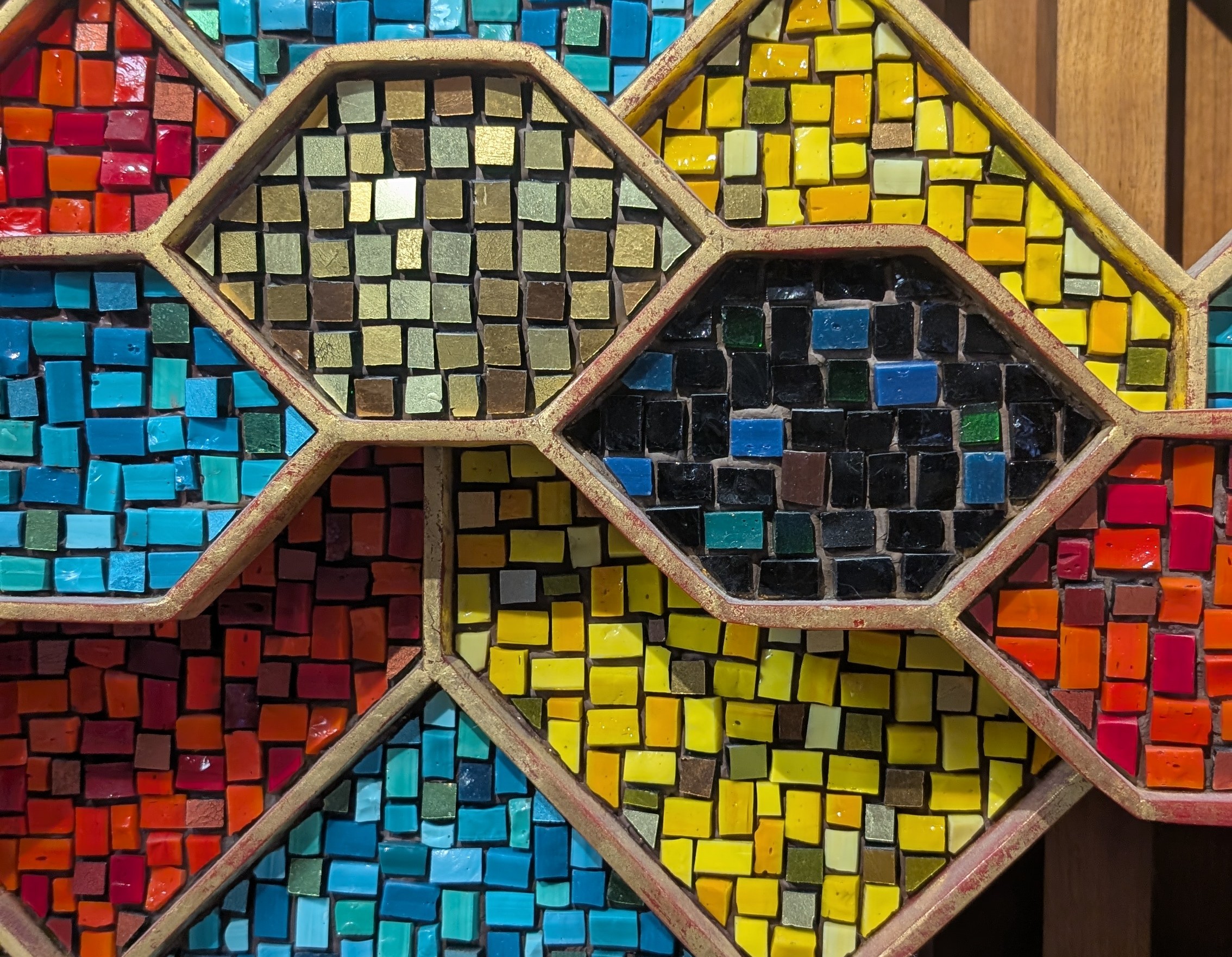
The mosaic is an innovative use of traditional techniques and modern materials. It is composed of Venetian glass tesserae (smalti) encased in a polyseter resin construction.
Watrous spent more than a half century on the UW-Madison campus, beginning as a student (BA'31, MA'33, PhD'39), followed by 41 years on the faculty, as both a professor and chair of the Department of Art History within the College of Letters & Science. He is recognized as the driving force behind the establishments in 1970 of the Elvehjem Art Center, now known as the Chazen Museum of Art.
Art conservation treatment completed in May 2019, with financial support from the College of Letters & Science.
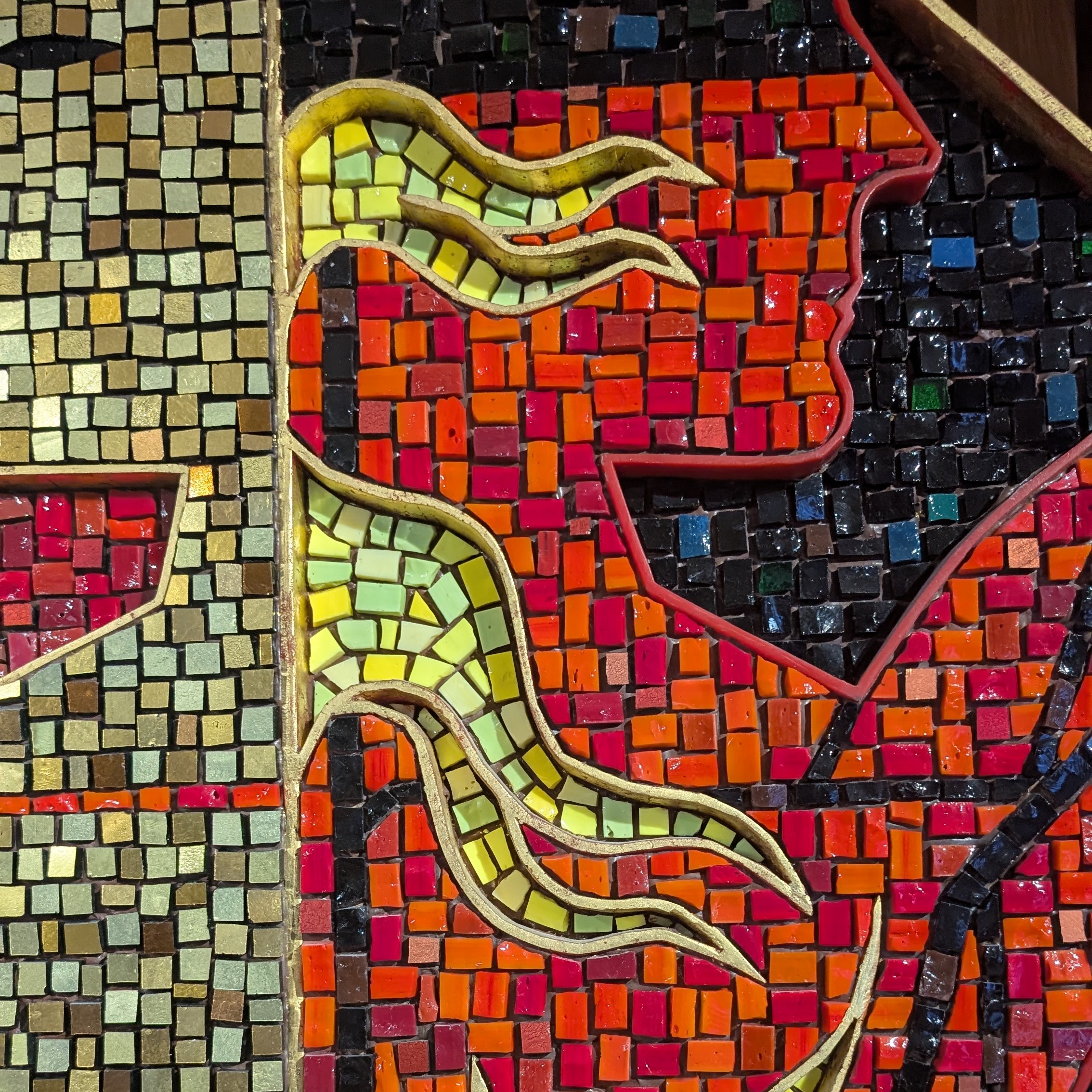
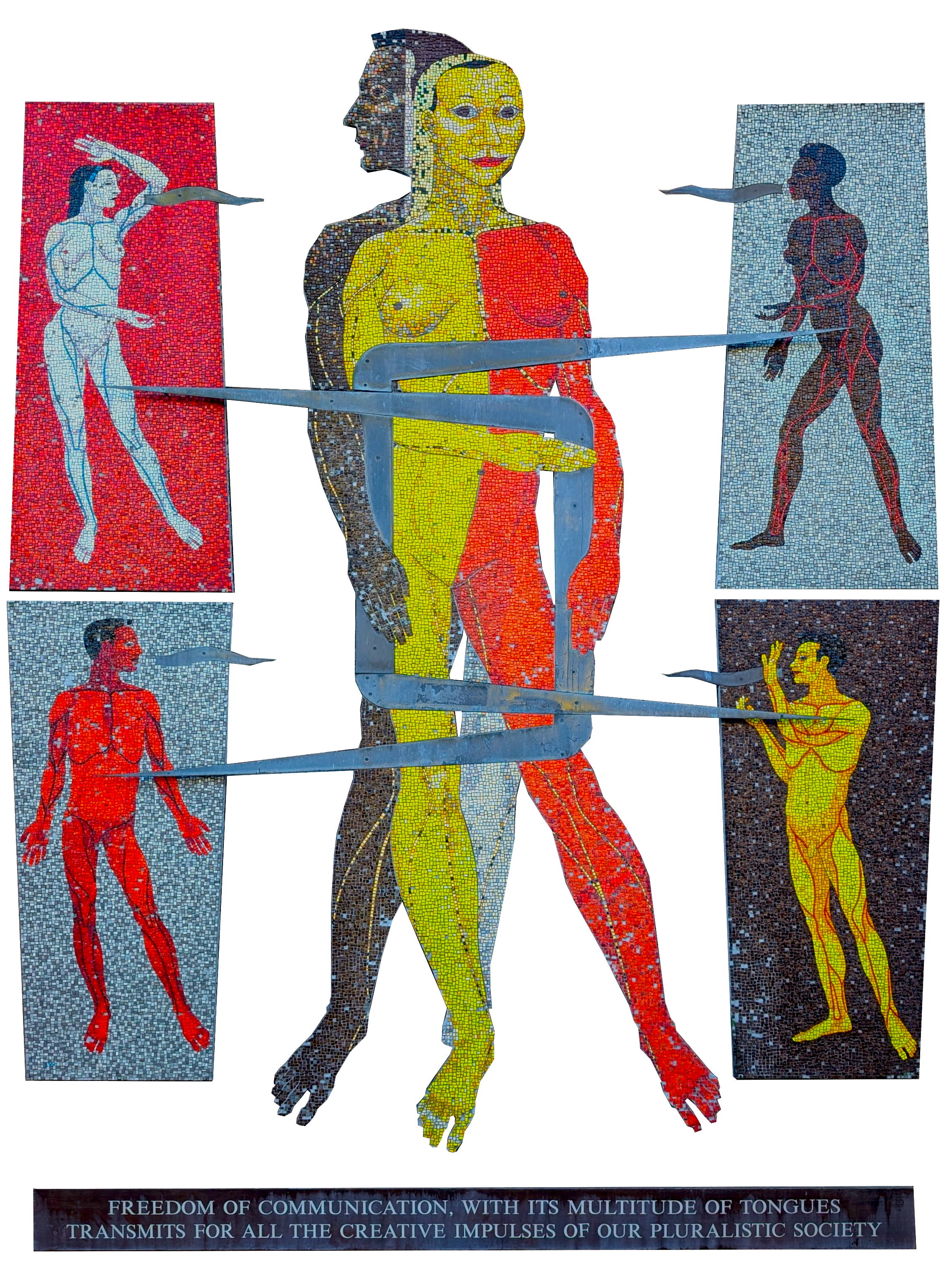
Freedom of Communication - 1973
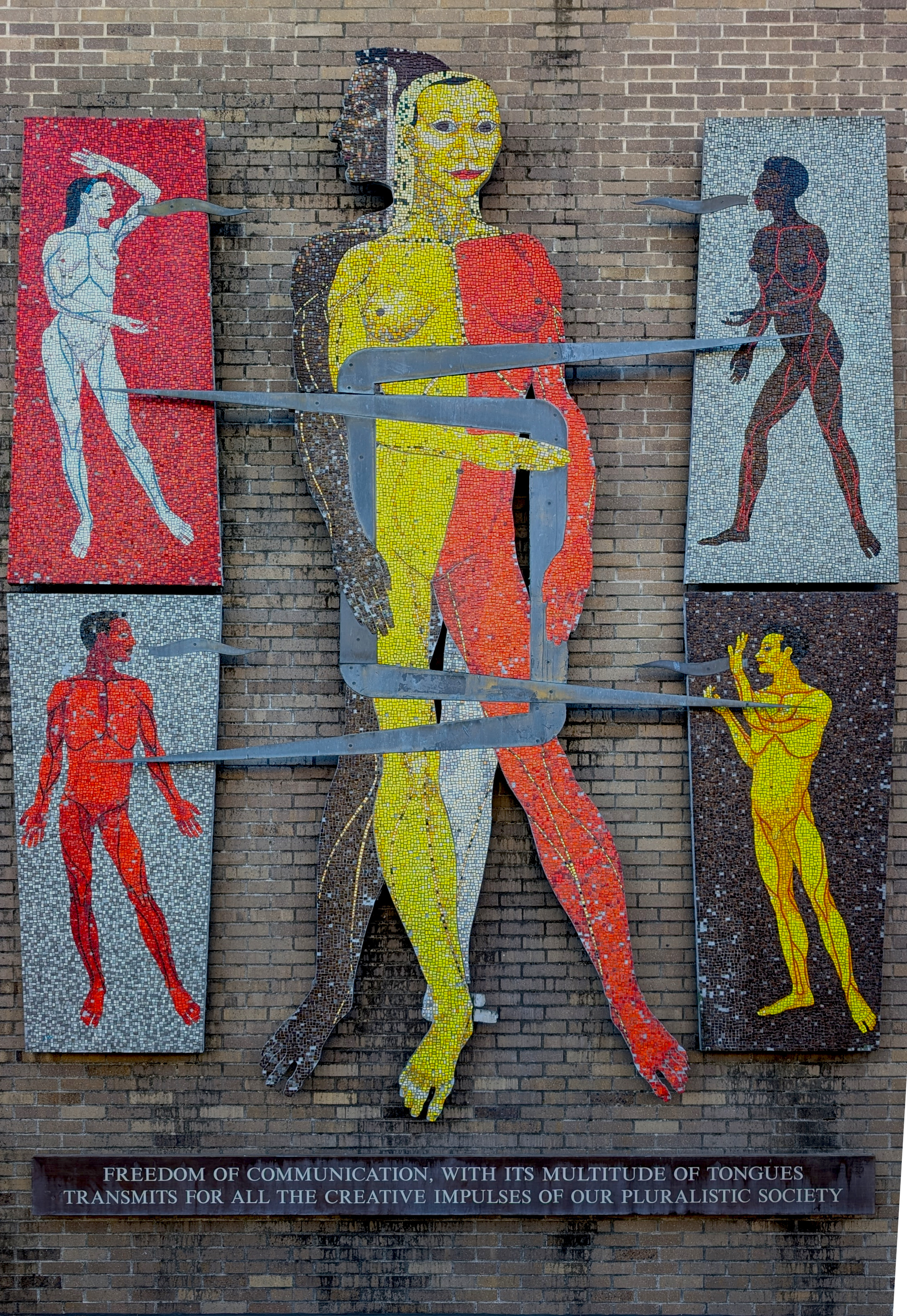
Located on the north wall of Vilas Hall.
From the Smithsonian:
Sculpture is a brightly colored mosaic inspired by Supreme Court decisions on freedom of speech, with depictions of nude figures of different races, colored white, red, black, and yellow. In the center are two large central figures of a female and a male. She wears only a scarf, her body and skin color merging with the man standing behind her, his head turned to the left. They are flanked by four polygonal panels, one in each corner, each with a figure making communicative gestures, their heads turned toward the central figures. In the upper left panel is a female, with male figures in the remaining panels. Panels are each connected to the two central figures by a brass plated arrow-shaped connector representing Language. The mosaic is on a plywood backing, attached to a brick wall by steel hangers and bolts.
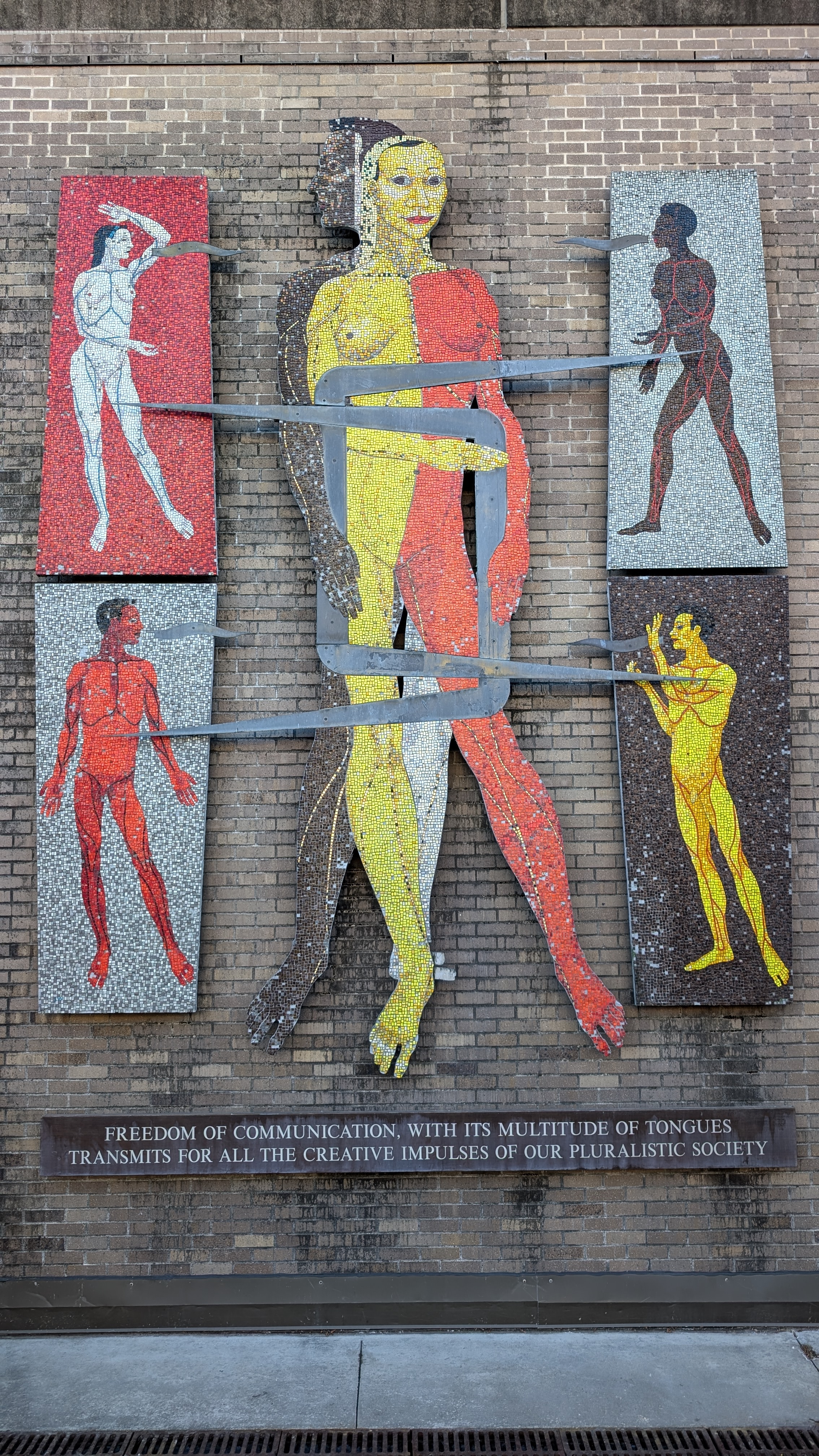
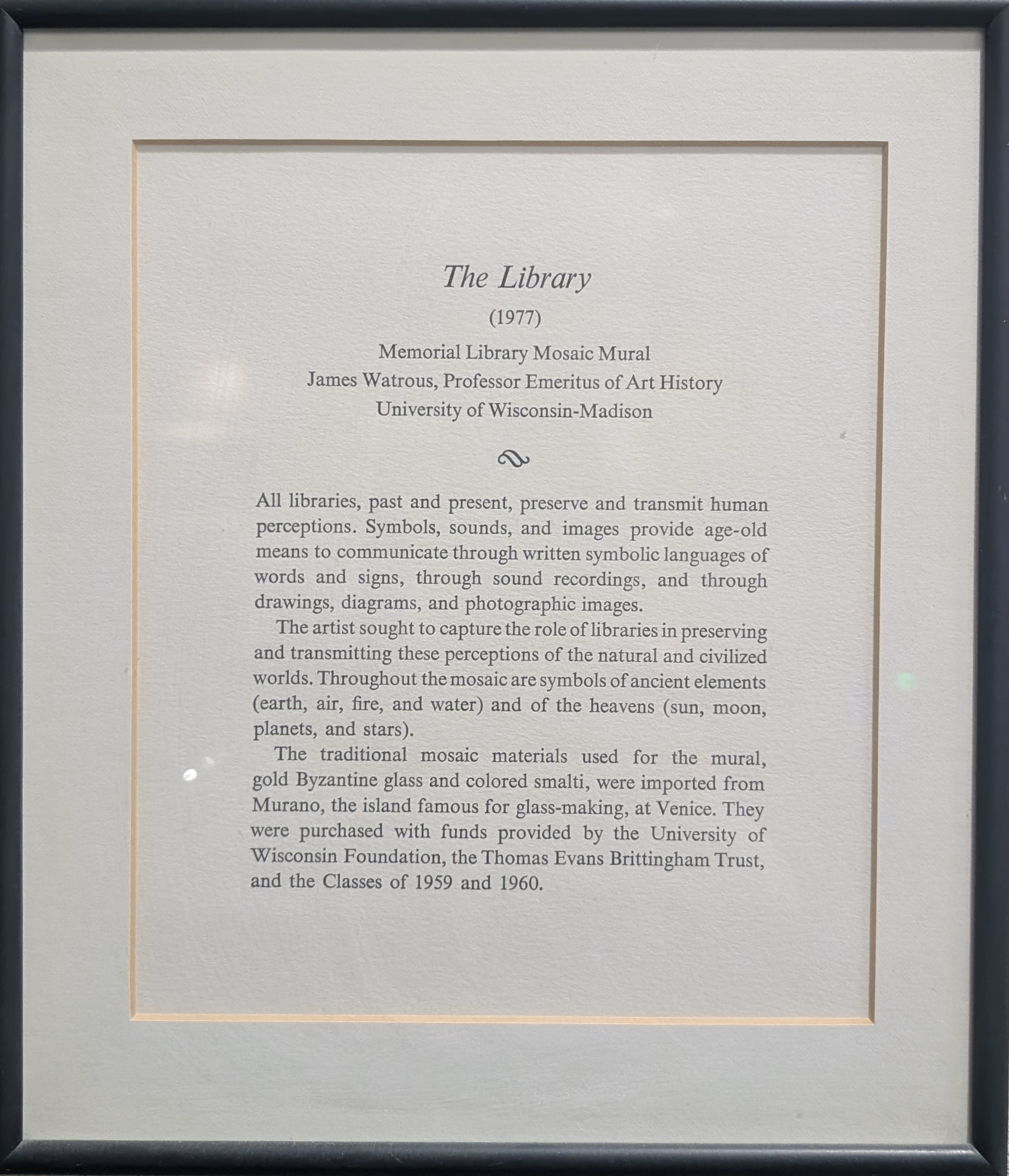
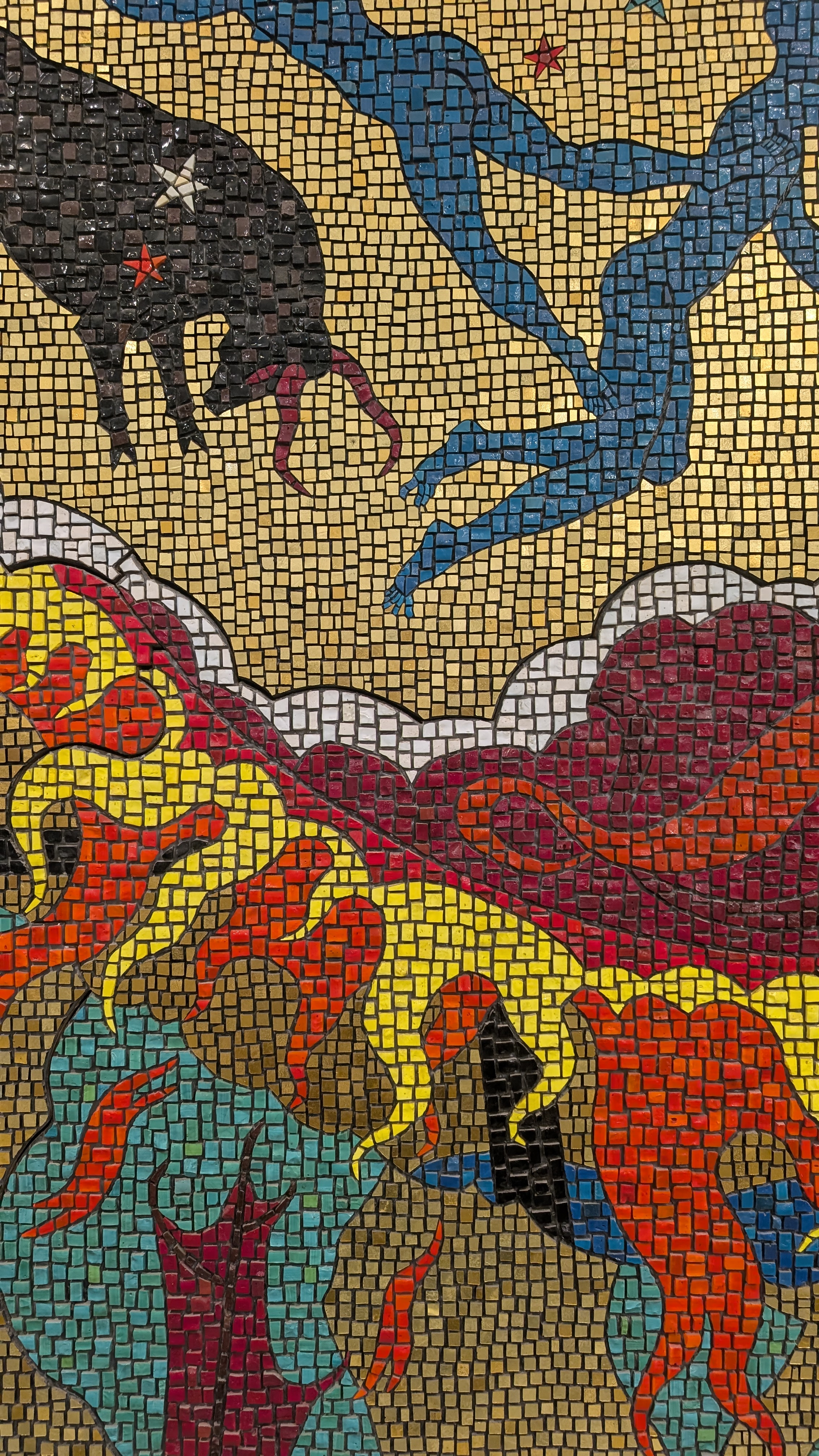
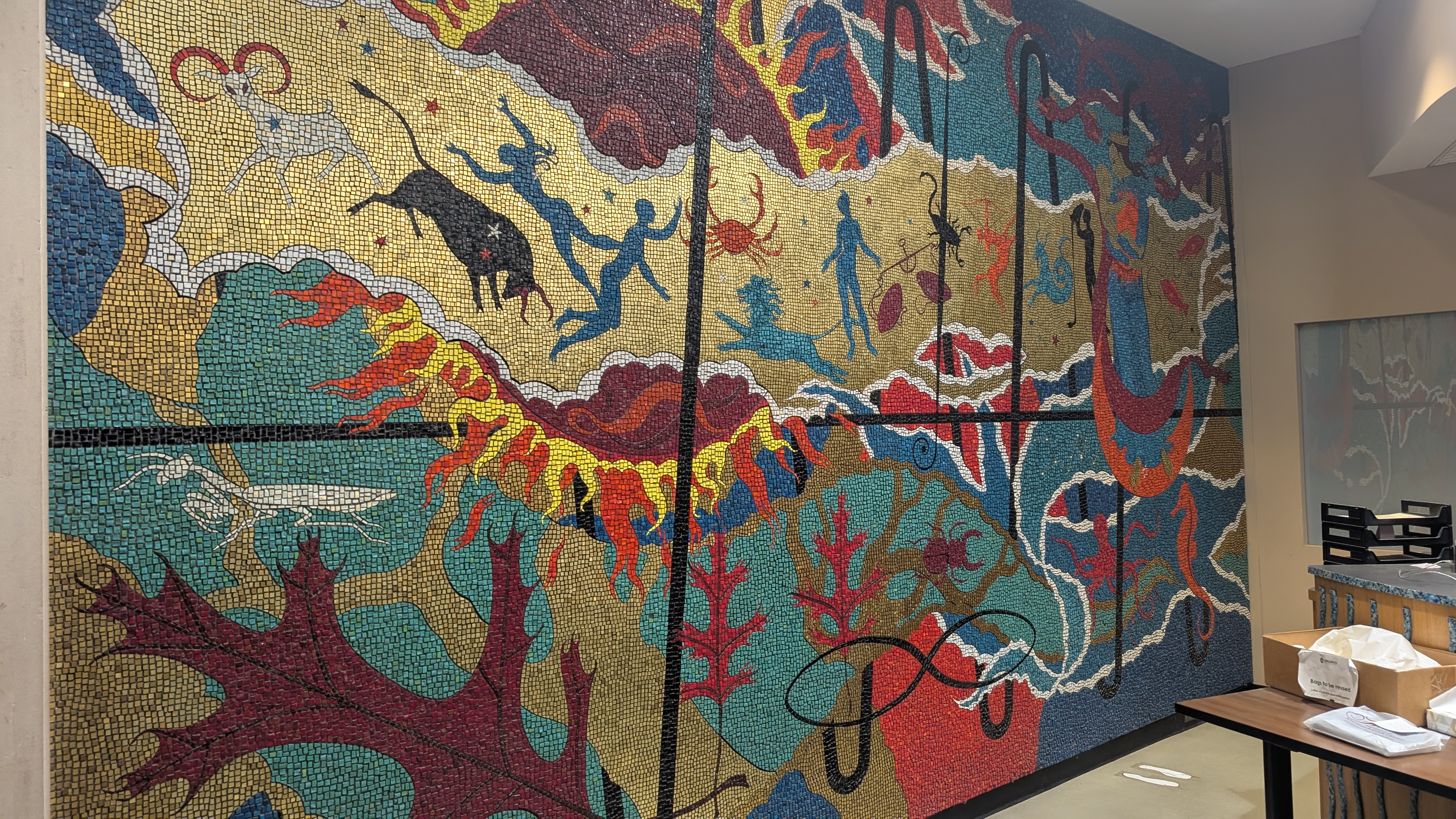
The Library - 1977
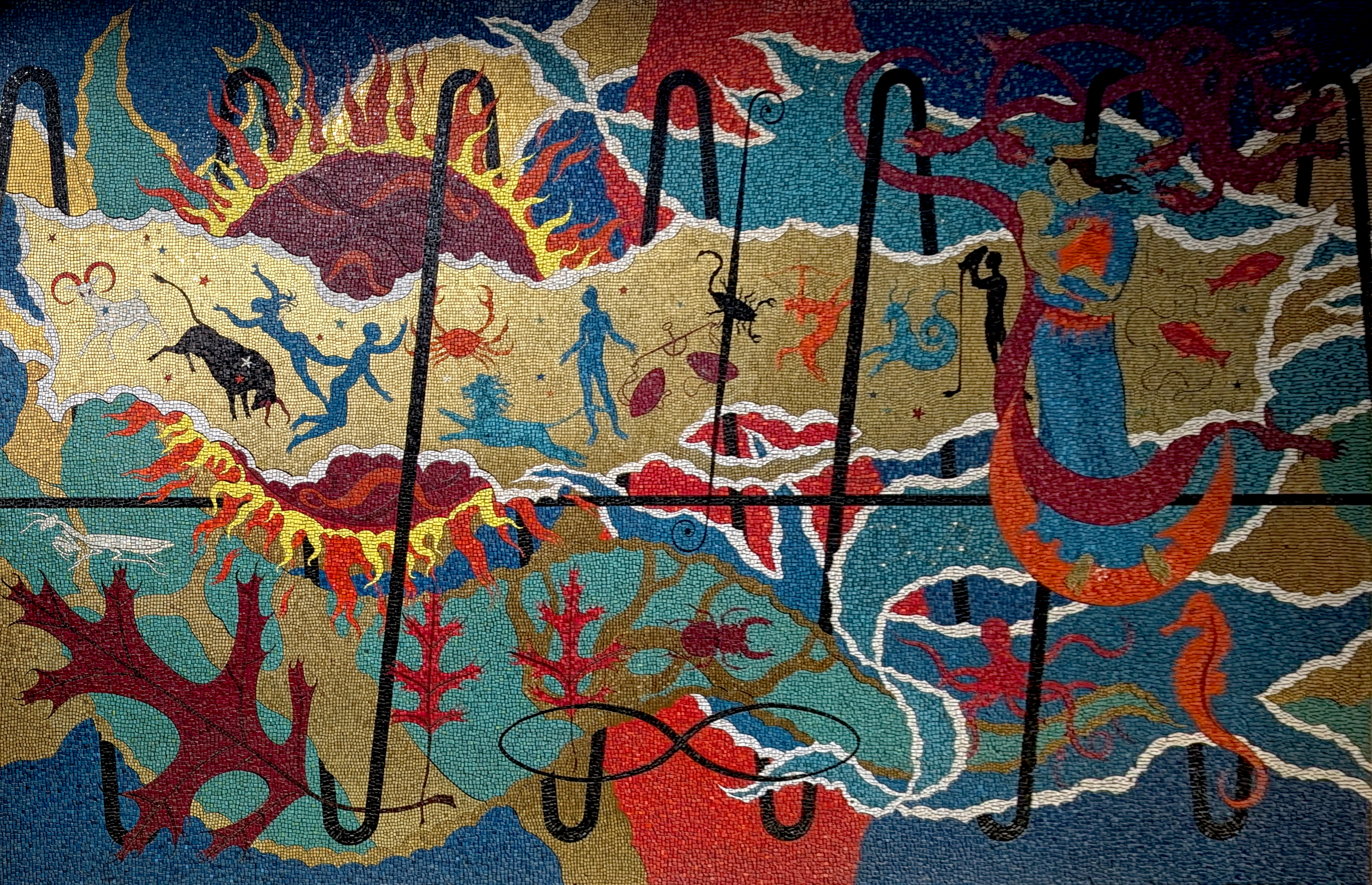
Located in the entrance of Memorial Library.
From plaque:
Memorial Library Mosaic Mural. James Watrous, Professor Emeritus of Art History. University of Wisconsin-Madison.
All libraries, past and present, preserve and transmit human perceptions. Symbols, sounds, and images provide age-old means to communicate through written symbolic languages of words and signs, through sound recordings, and through drawings, diagrams, and photographic images.
The artist sought to capture the role of libraries in preserving and transmitting these perceptions of the natural and civilized worlds. Throughout the mosaic are symbols of ancient elements (earth, air, fire, and water) and of the heavens (sun, moon, planets, and stars).
The traditional mosaic materials used for the mural, gold Byzantine glass and colored smalti, were imported from Murano, the island famous for glass-making, at Venice. They were purchased with funds provided by the University of Wisconsin Foundation, the Thomas Evans Brittingham Trust, and the Classes of 1959 and 1960.
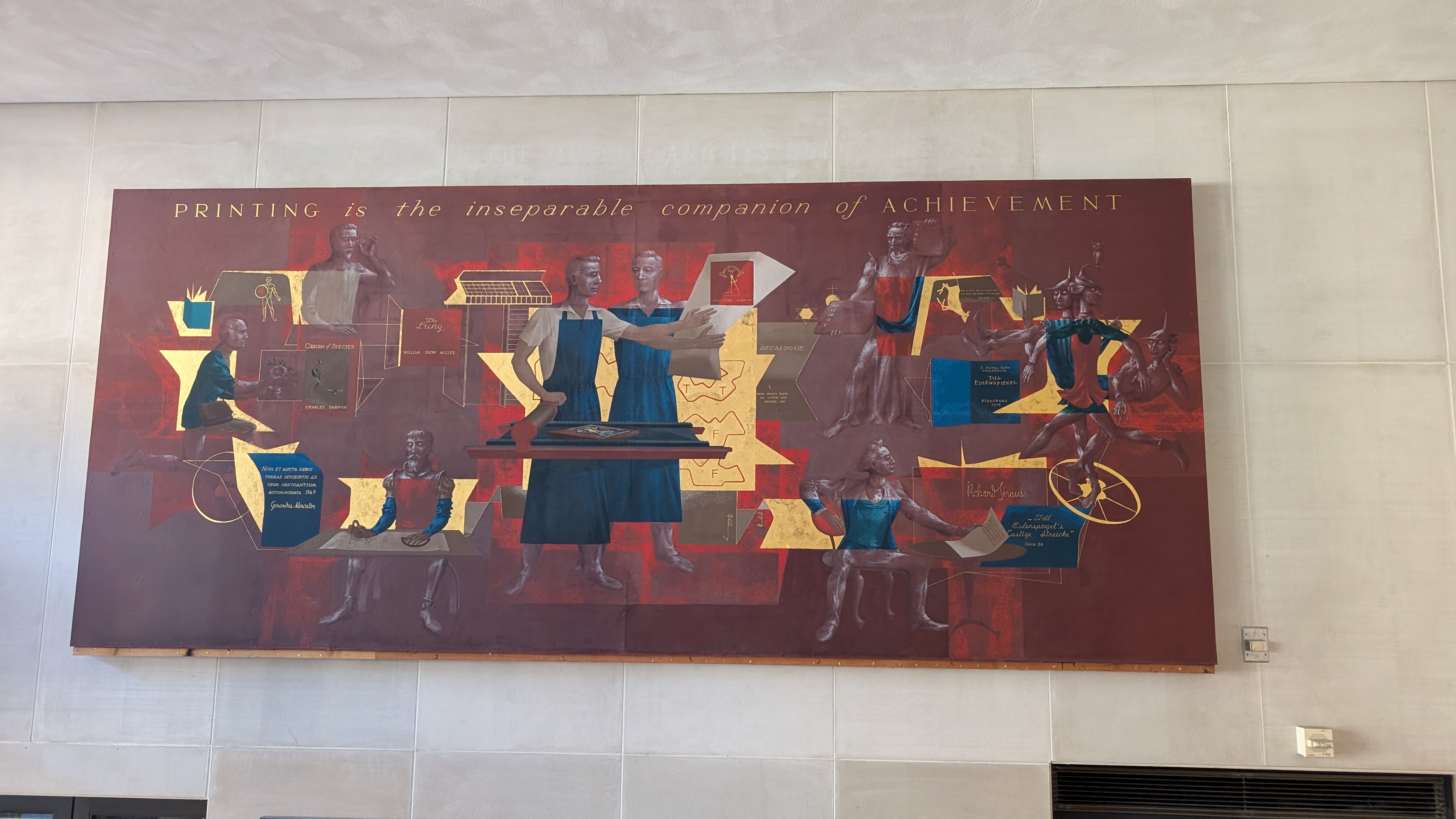
Printing is the Inseparable Companion of Achievement - 1951
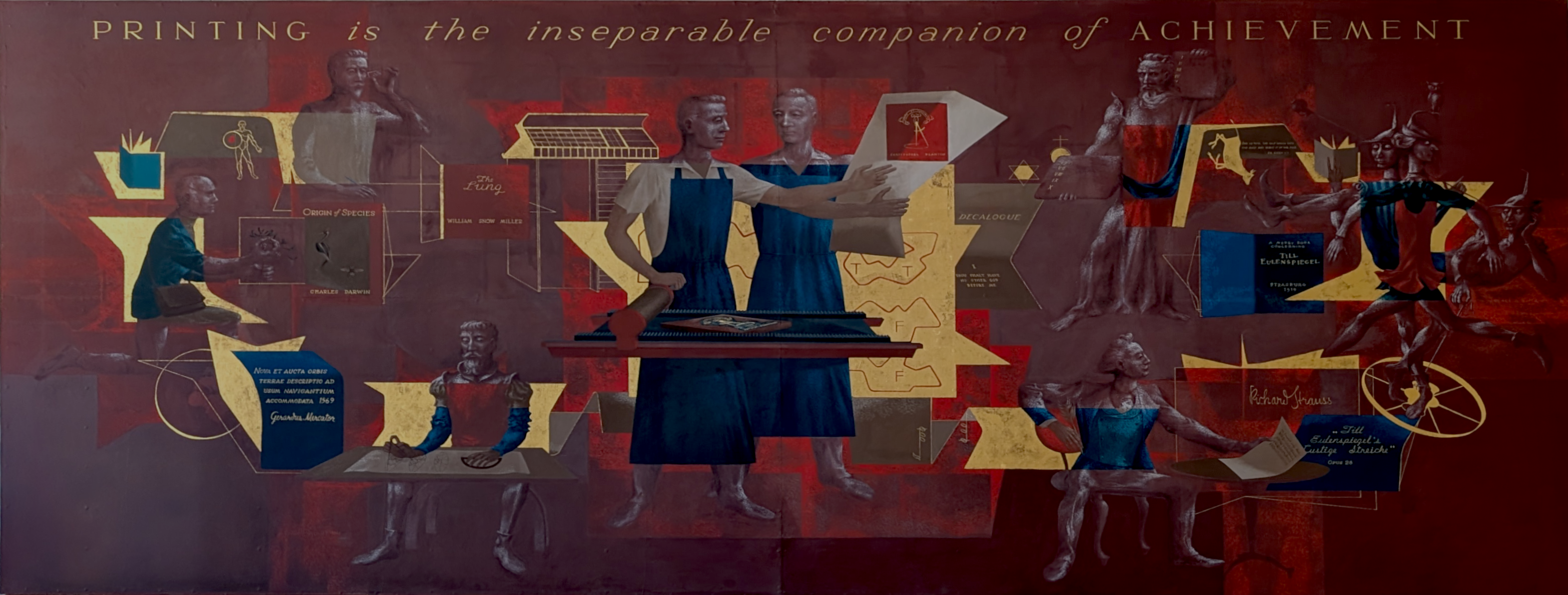
Located in the north entrance of the Elvehjem building.
From Chazen Museum:
In February 2020, this mural by James Watrous was moved from Webcrafters, Inc. (formerly The Democrat Printing Co.) on North Sherman Ave. in Madison. Commissioned by Walter A. Frautschi for The Democrat Printing and painted in their offices, the mural addresses the role of printing in the dissemination of knowledge. The subject of the mural was proposed by the company and is drawn from a series of personal letters of advice written in 1920 by Roy T. Porte, a printer and publisher. The artist—a former faculty member in UW’s art history department from 1935-1976— was known as "the Father of the Elvehjem" for his pivotal role in establishing the Elvehjem Art Center (now the Chazen Museum of Art) and the Kohler Art Library. Watrous also created many works of art in public spaces around campus, including the Paul Bunyan murals (1933-36) in the UW-Madison Memorial Union.
Unmade Eagle Mosaic - 19??
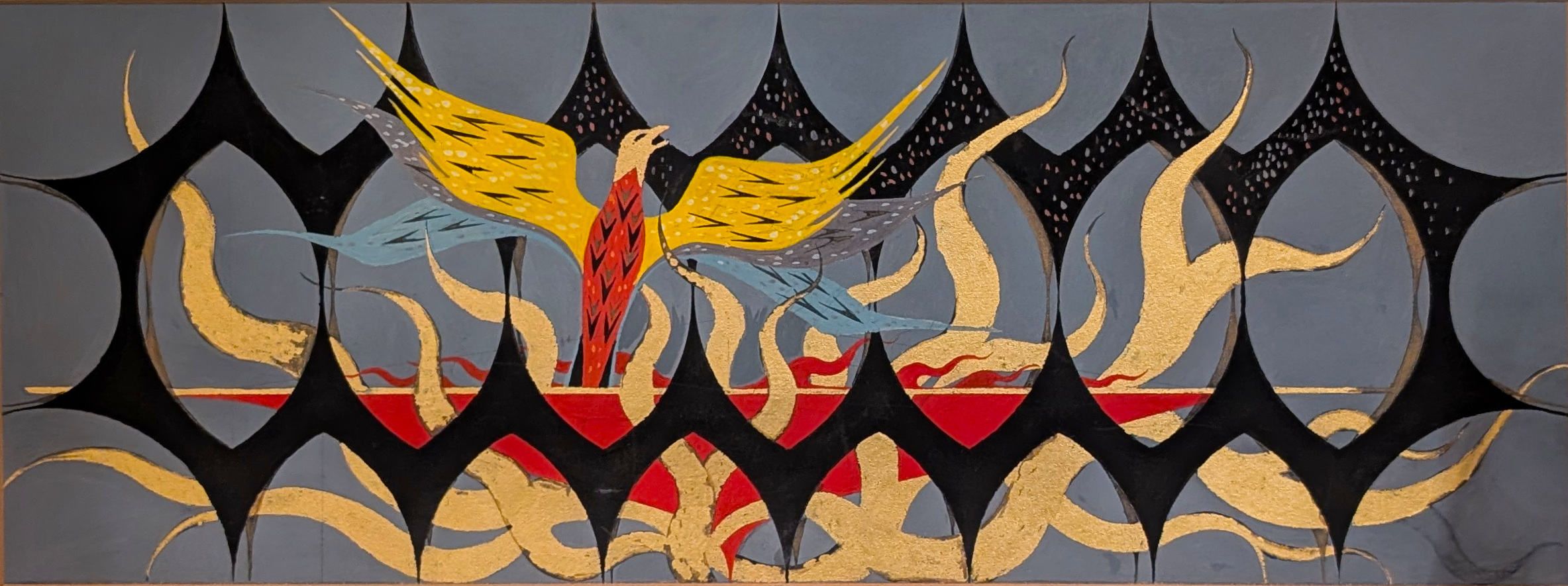
On the shelves of the Elvehjems Hagen room.
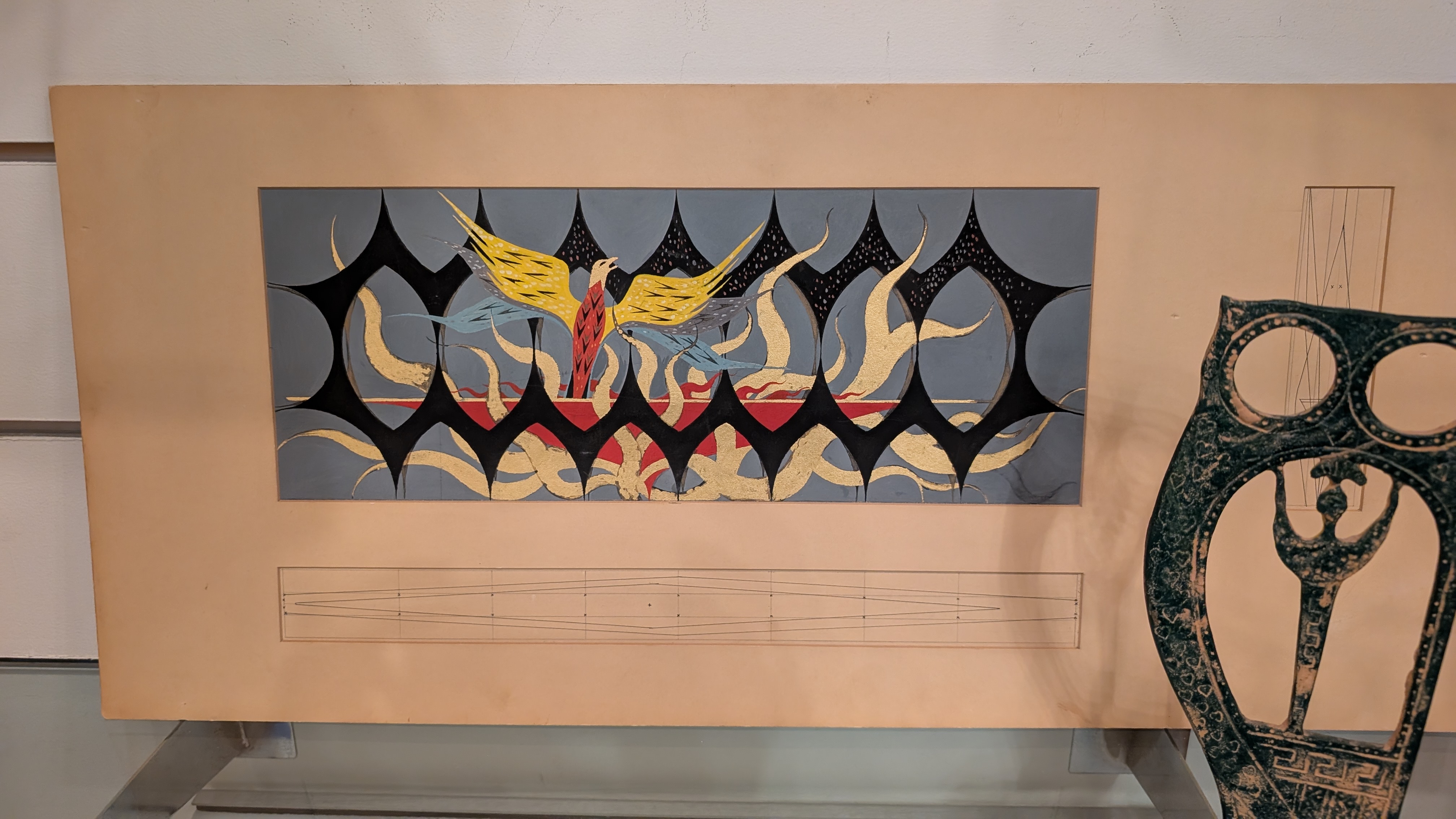
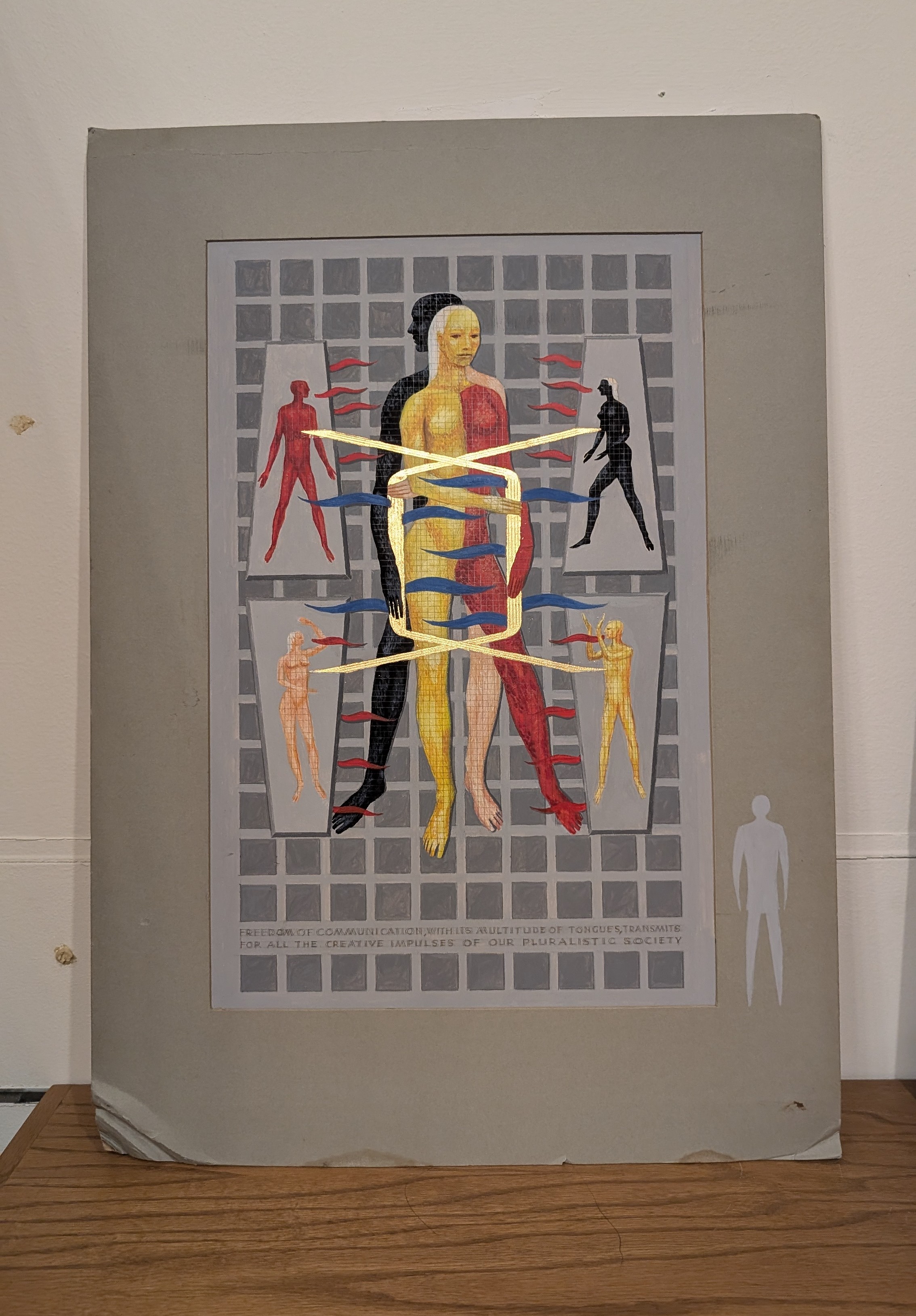
I cant find any information on this painting, although it unmistakably is the work of James Watrous. It is painted on foam board and displayed in a classroom of the art history building, near another painting of the Vilas Hall Freedom of Communication mosaic. Below and to the side of the illustration are additional diagram looking things, which I have no idea the meaning of.