my research on telescoping control rods in gas cooled reactors
Since Freshman year, I have been participating in undergraduate research with the ReTI lab at UW-Madison. The project I took on was investigating the use of telescoping control rods in prismatic high temperature gas cooled reactors.
sections
Definitions - Background - Control Rods - Modeling - Data - Conclusions
Important definitions
High Temperature Gas Cooled Reactor, HTGR
A design of nuclear reactor that uses gas as its coolant rather than water, allowing it to reach higher temperatures. A prismatic HTGR is a HTGR that uses fuel blocks, as opposed to pebbles such as a pebble bed reactor.
Pressurized Water Reactor, PWR
A design of nuclear reactor that uses pressurized water as a coolant. The most popular type in the USA, with about 70% of our reactors being a PWR design.
Neutron Poison, Boron, B4C
A material that absorbs neutrons, preventing them from causing more fissions in the nuclear chain reaction. Whenever I mention adding boron, think reducing power.
Control Rod
Rod used to control the rate of reaction, or the power, of a nuclear reactor
Effective Neutron Multiplication Factor, keff
A measure of how many neutrons are being released in the reactor - above 1, more neutrons are being released in the reaction that went into it, causing an increase in power. Below 1, a decrease in power.
Project Background

Todays nuclear industry seems to be heading all in the same direction - smaller, scalable reactors. In the face of cost overruns when we do occasionally try and build new nuclear, the industry has opted to try and reduce initial costs by reducing the initial scale. Now every nuclear company worth their salt has 50 to 300 MW designs for the cautious buyer.
How they decided that this obvious policy and business issue should be solved by ditching the most economically advantageous aspect of nuclear reactors design, their enormous scale, and replacing it with neutronically & economically inefficient designs just so investors feel comfortable ponying up initial capital for nuclear instead of natural gas... I digress. In todays world, smaller is better.
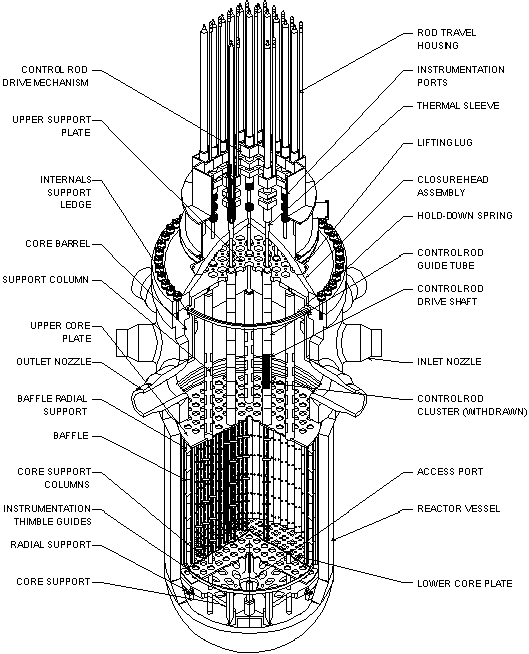
But this isn't all bad. There are many aspects of conventional reactor designs that can benefit from being scaled down, reducing construction consts while retaining scale. Take for example (the topic which the rest of this article is about), control rods. In most reactor designs (primarily PWR & HTGR), the control rods are inserted from the top of the reactor pressure vessel (RPV) to the bottom of the fuel region. But this means that when the control rods are un-inserted, they take up a large amount of space at the top of the RPV, which must have dedicated space for them to be stored. If we were able to reduce the size of these control rods when they are un-inserted, we would be able to open up a lot of space for the systems above the reactor, or even just reduce the size of the reactor assembly itself. That is why we are investigating telescoping control rods, specifically in prismatic HTGRs.
telescoping control rods
What are telescoping control rods? We should first look at conventional control rods. In most prismatic HTGRs, as well as many pressurized water reactors, the control rods are a long annular rod that are inserted from the top of the reactor and span to the bottom of the fuel region when fully inserted. They are made of a neutron poison such as B4C or Hafnium, as well as a cladding to protect them from wear. This allows you to easily control the reactivity in the reactor by inserting and un-inserting the control rods.
Something important to note is that the means of controlling reactivity in an HTGR are limited. In a PWR, there are many - burnable poisons (small amounts of neutron poisons meant to eventually be used up during the fuel cycle) are added to the fuel to normalize flux peaks, boron can be added or removed from the water to either decrease or increase reactivity, and control rods can be inserted or un-inserted. In fact, during normal operation the control rods are completely un-inserted, and all minor adjustments to the reactivity are made by changing the concentration of boron in the water. But in an HTGR, the coolant is helium, and we can't rely on boron for control. We instead partially insert the control rods into the core during operation to control the power.
Telescoping control rods are very similar to these conventional control rods. They use the same poison and cladding, but instead of being one continuous rod, they are instead split into multiple stages which nest inside each other. They are driven using a cable attached to the innermost stage, giving it a characteristic insertion where initially all stages come out together, followed by its inner stages until eventually only the last stage comes out. To allow for similar coolant flow, each stage is thinner that its conventional counterpart, causing the total rod volume to be about 40% the size of a conventional rod.
This allows for much more compact storage: a three stage telescoping rod is able to span the entirety of the fuel region, but takes up only 1/3rd the space that a conventional rod takes up. This effectively removes the need for the additional volume in the RPV head for the un-inserted control rods, reducing the size and cost of the reactor.

Modeling the HTR50S
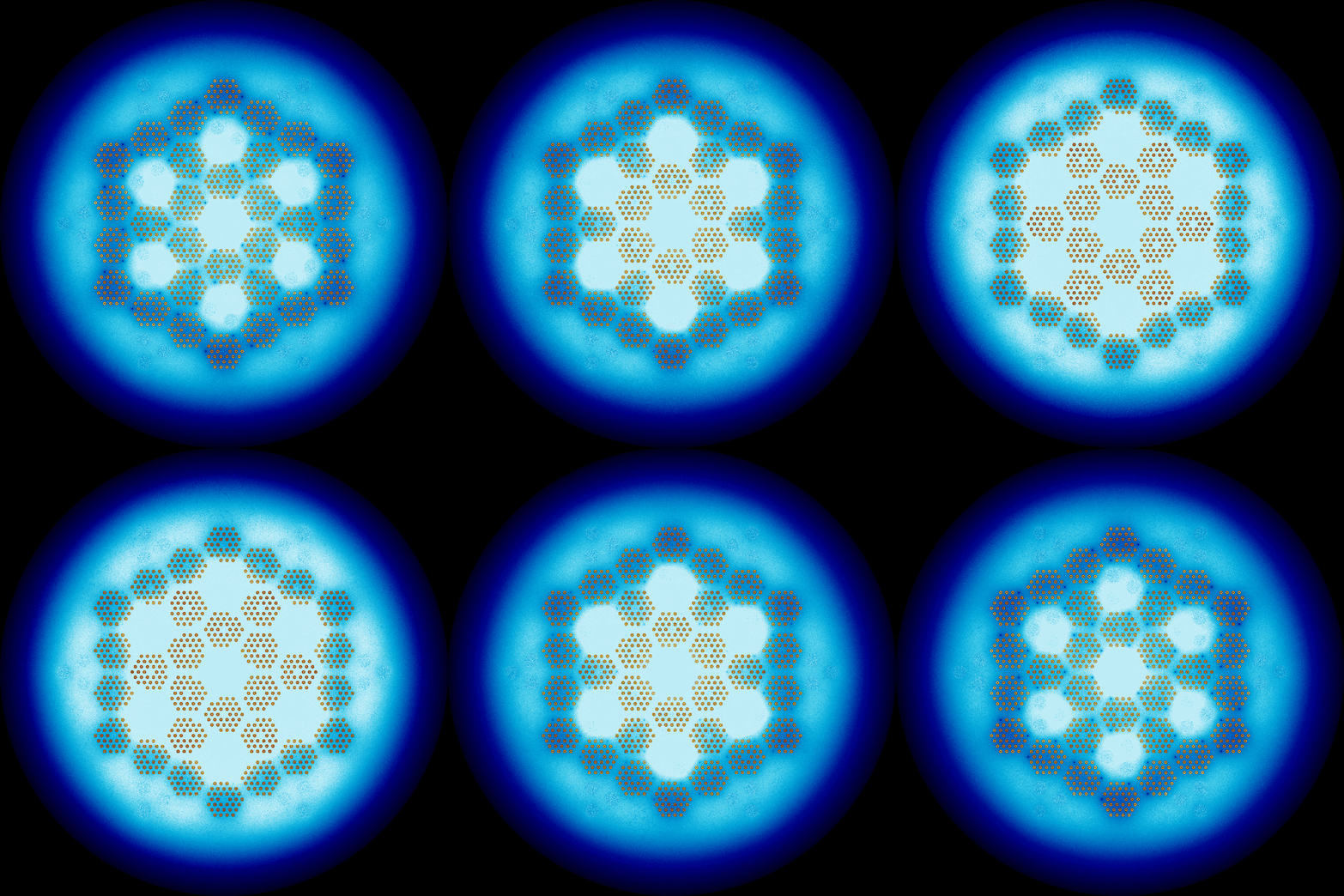
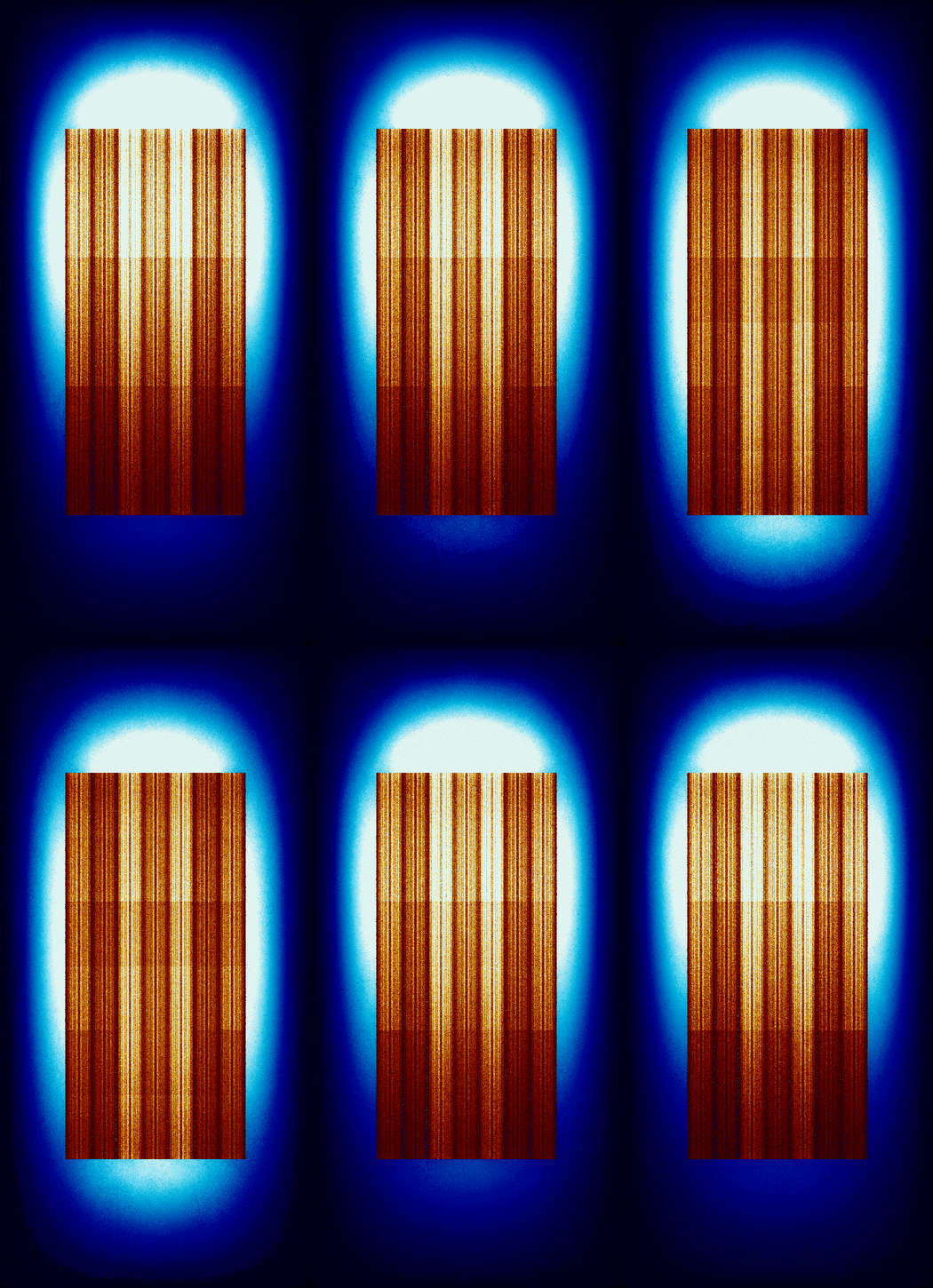
The majority of the time on this project was spent learning to use Serpent 2 to model the HTR50S.
The Serpent 2 documentation has a very useful tutorial section, which covers the basics of making a model, and a syntax manual that... I struggled with. This project would have been impossible with that as my only resource. What I mainly used was a pre-existing model of the HTTR from the Serpent Wiki and asking my supervising grad-student a lot of questions. That being said, they are working on re-writing the documentation!
(Old man yells at cloud side tangent: In this modern age, it is engrained into us that our first source of information should be Google or AI. But for projects like this, the most effective source of information will always be from people, knowledgeable people who have made all the mistakes you will and can guide you away from them. Go talk to them!)
Once the Serpent code was written, it was just a static model. To compare different control rods, I needed a method to easily iterate between different insertion depths and control rod types. To do this, I wrote a script in python that allows you to choose control rod stages & control rod insertion (as well as some other parameters) and generates all the input files needed.
You can check out all the code I wrote for this project on GitHub.


Analyzing the Data
With our reactor modeled, we can run neutronics simulations at each insertion level of the control rods, allowing us to plot the keff against insertion. Comparing these plots for each of the control rod types we get... very similar curves. Surprisingly similar.
But if we are using nearly 60% less poison in our control rods, how is it possible that the results are so similar? Shouldn't the curve be 60% smaller?
In the normal operation of a control rod, much of the neutrons are stopped by the outermost layer of poison. This leaves the inner poison relatively untouched throughout the lifetime of the rod. When you remove a large amount of the poison, the effect persists - but now the amount "untouched" poison is smaller. Thats why you only see a different at the very end of the fuel cycle, as the outermost layers have burned up and the neutrons are reaching the smaller volume of poison.
The way my PI put it is that it doesn't matter if theres 1 crocodile in a pond or 10, if you throw a puppy in the results are going to be the same. I don't know why he always uses metaphors based on harm to animals. I think its a british mannerism. My grandpa does the same thing.


Conclusions
This was my first experience ever getting hands on with nuclear research. I went from only having read books about nuclear technology and history to modeling reactors and doing neutronics analyses. I learned a lot - but my main takeaway is that you don't need formal education to learn things. The purpose of university is not the degree, but to give you the resources to be able to explore and learn about what interests you. So if you want to learn about nuclear, or anything else that interests you, don't feel like you need to take a class on it first. Talk to others doing it, read a textbook, and just start making something.
- keeperofhoney, 2026